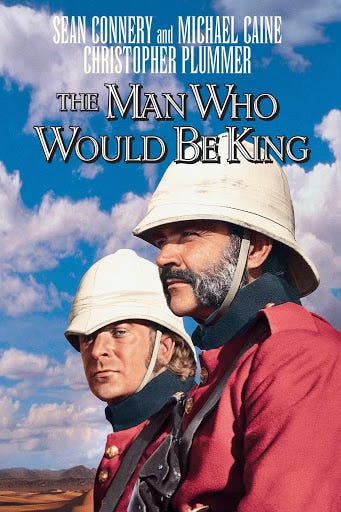
In 1975, John Foreman—Paul Newman’s producing partner—was headed to Morocco to produce The Man Who Would Be King with Sean Connery and Michael Caine. Foreman liked the dialogue in Hombre and asked Elmore Leonard if he had something for the two stars. Dutch wrote six pages overnight, a treatment he called The Hawksbill Gang, and sent it in care of the airline in New York.
Foreman called from the airport: “Great story. Expand it.” Dutch wrote a 50-page treatment and flew to Morocco to pitch it in person. Dutch went and ended up hanging around the set and hotel until Connery and Caine were available. After several days, he sat down with them and they expressed their serious interest. Dutch went home thinking it was a done deal and he was going to write the screenplay. But then Foreman called and said they changed their mind because all the scenes in England would have been prohibitively expensive to film because of that country’s tax laws.
Dutch asked his publisher, Delacorte, if they saw a book in the treatment and they said they did not.
The Hawksbill Gang is set in 1938, in what Dutch describes as Dickensian England—grimy industrial towns, petty crooks, pawn shops, and public houses filled with hustlers and schemers. It’s a classic Leonard caper: sharp, funny, and wicked. It follows a ragtag outfit led by Tony Smudgeon, the good-natured nephew of Lord Smudgeon, aka the Duke—a crooked British aristocrat who’s stashed a fortune in a Spanish bank—just as the city falls under siege by the Loyalists during the Spanish Civil War.
With time running out, the Duke sends Tony to retrieve the money, teaming him up with two questionable allies: Harry Mold, a smooth-talking operator with questionable credentials, and Billy Hawksbill, a loudmouthed scrapper with strong opinions and a wild streak.
The trio poses as British military observers to gain access to the war zone. What begins as a quick recovery job turns into a dangerous run through shifting frontlines, corrupt officials, and revolutionaries with their own agendas. The Duke doesn’t trust his nephew, so he dispatches two hired goons to keep tabs—and, if necessary, take control.
After a series of double-crosses, detours, and stolen transport, the Hawksbill Gang ends up in North Africa with the money—one step ahead of the men sent to stop them.
The Hawksbill Gang is another great example of Dutch’s spontaneous, improvisational creativity—his strength as a writer, and the kind of storytelling that set him apart.


This would have made a great movie.